Latest News
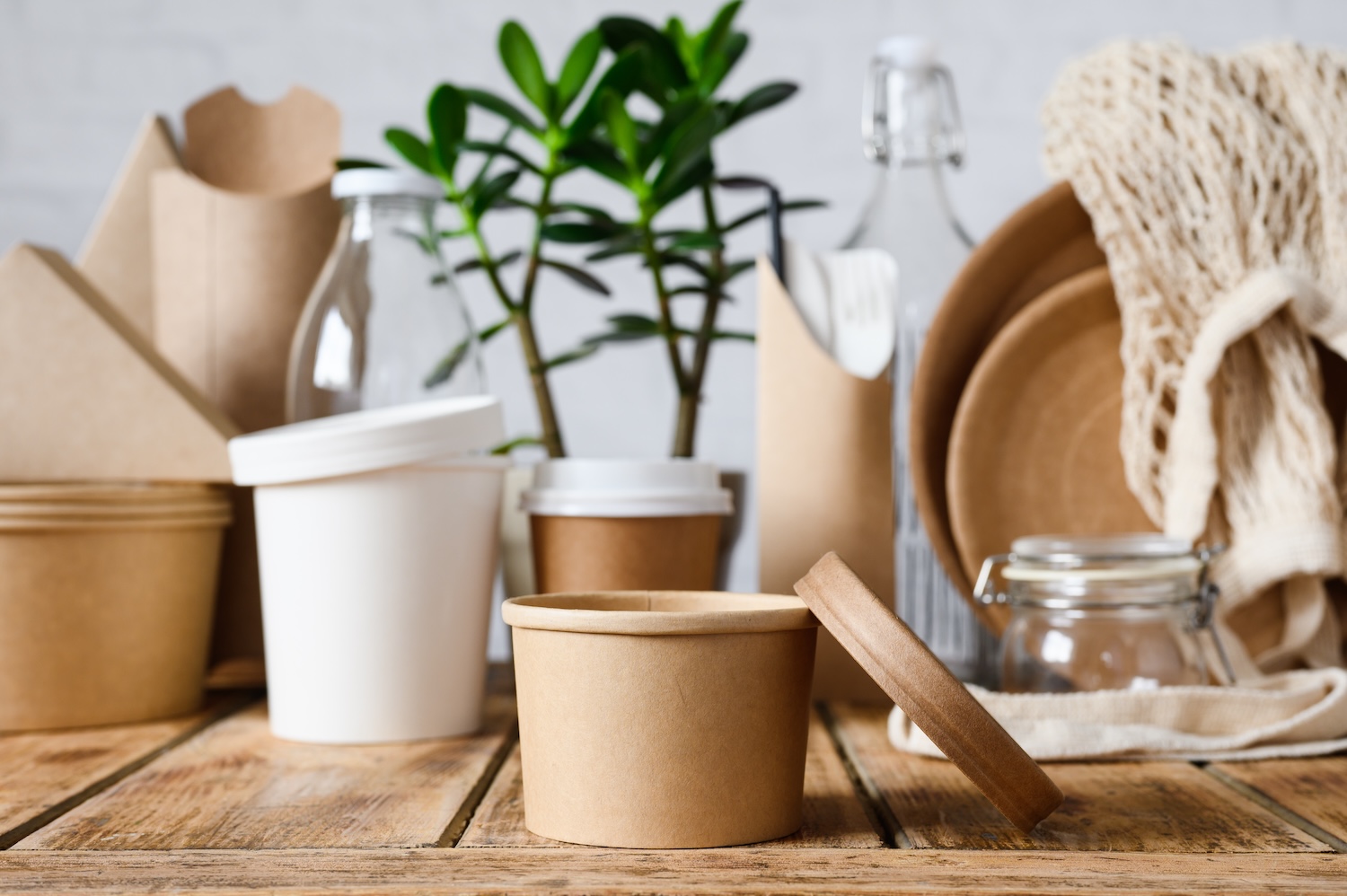
Fresh produce is one of the most demanding product categories to package. It bruises easily, releases moisture, wilts under the wrong conditions, and loses visual appeal within hours if packaging fails. For UK food businesses serving salads, prepared fruit, deli items, and fresh baked goods, choosing the right packaging directly affects food quality, waste levels, and whether customers return.
Growing numbers of food business operators also want their packaging to reflect their values. Single-use plastic is increasingly unwelcome on the high street and at food markets. The challenge is finding packaging that genuinely protects fresh food while meeting eco-friendly standards without inflating costs or compromising practicality. This guide covers the specific challenges of packaging fresh produce, breaks down which formats suit which food types, and explains how to make choices that are both operationally sound and sustainable.
Packaging fresh produce is more complex than packaging hot takeaway meals or dry goods. Fresh food is perishable, high in moisture content, and visually driven. Understanding the specific pressures fresh produce places on packaging helps food businesses make better purchasing decisions.
Fresh fruit, leafy salads, and prepared vegetables release moisture after being cut and packed. If that moisture has nowhere to go, it pools at the base of the container, turning crisp leaves limp and causing condensation that obscures the product. Effective packaging to protect fresh produce needs ventilation features, absorbent base materials, or designs that allow airflow without compromising food safety. Bagasse trays, made from sugarcane fibre, naturally absorb small amounts of moisture, making them a practical option for items that release liquid during storage.
Crushing is a constant risk with fresh produce, especially berries, pastries, layered salads, and delicately prepared items. Clamshell boxes and rigid salad containers provide the structural support needed to prevent damage during transport and stacking. The cost of food wasted through packaging failure almost always exceeds the cost difference between a budget container and a properly rigid one.
Fresh produce sells on appearance. Clear lids and transparent containers serve a commercial purpose, not just an aesthetic one. Deli pots with clear walls and salad boxes with hinged transparent lids allow the food to do the selling. For food market traders and deli counters, packaging that showcases colour and freshness drives impulse purchases far more effectively than opaque boxes.
All packaging in direct contact with food must comply with UK food contact material regulations, retained from EU Regulation (EC) No 1935/2004. These require that materials do not transfer harmful substances to food in quantities that could endanger health or cause unacceptable changes in composition, taste, or odour. Food-grade kraft board, PLA-lined containers, and sugarcane fibre bagasse products are all widely used for food-safe packaging of fresh produce in the UK food service sector.
Packaging must hold its structural form at refrigeration temperatures without becoming brittle or warping. Bagasse and kraft-based containers typically perform well in chilled environments, while PLA-lined products maintain their integrity in standard refrigeration ranges. Confirm suitability with your supplier before committing to a new format.
There is no single format that works for every type of fresh produce. Matching the right container to the right product protects food quality, reduces waste, and ensures customers receive their food in the condition you intended.
Portion salads, grain bowls, and mixed leaf servings need containers that offer depth, a secure closure, and visibility. Disposable salad boxes with hinged lids are the standard choice for delis, salad bars, and café counters. These containers feature a clear lid that lets customers see the contents, with a base deep enough to hold dressings without spillage. Matching container volume to your standard serving size is a small detail that significantly affects perceived value.
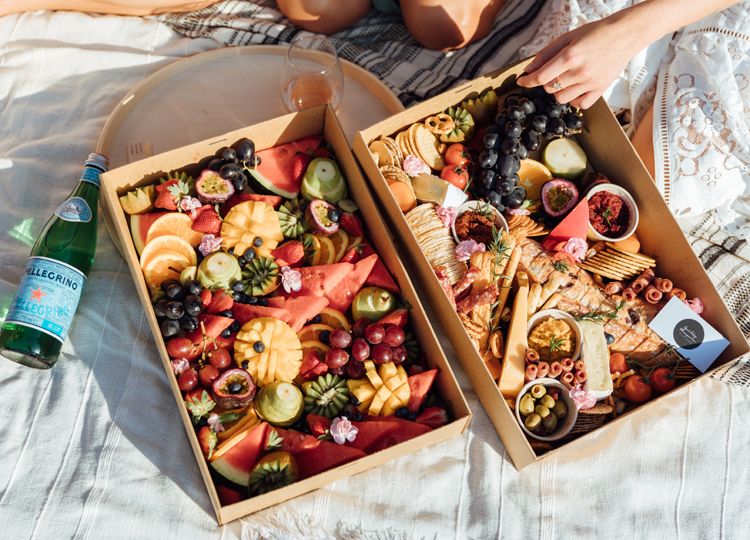
Clamshell boxes provide a rigid, enclosed shell that protects delicate items from crushing and contamination. They are widely used for croissants, muffins, sushi portions, and prepared fruit platters. For bakeries and dessert businesses, clamshell boxes offer a clean, professional presentation that keeps products intact during customer transit. Formats are available in both clear plastic and compostable materials, including kraft and bagasse clamshells for businesses reducing plastic use.
Deli pots are the workhorse of the prepared food counter, used for hummus, coleslaw, pasta salads, fruit pots, overnight oats, and dipping sauces. Clear-walled deli pots are particularly effective in chilled display units where the visual appeal of the food drives purchasing decisions. Standardising on a small range of sizes, typically 8oz, 12oz, and 16oz, simplifies stock management and makes pricing more consistent.
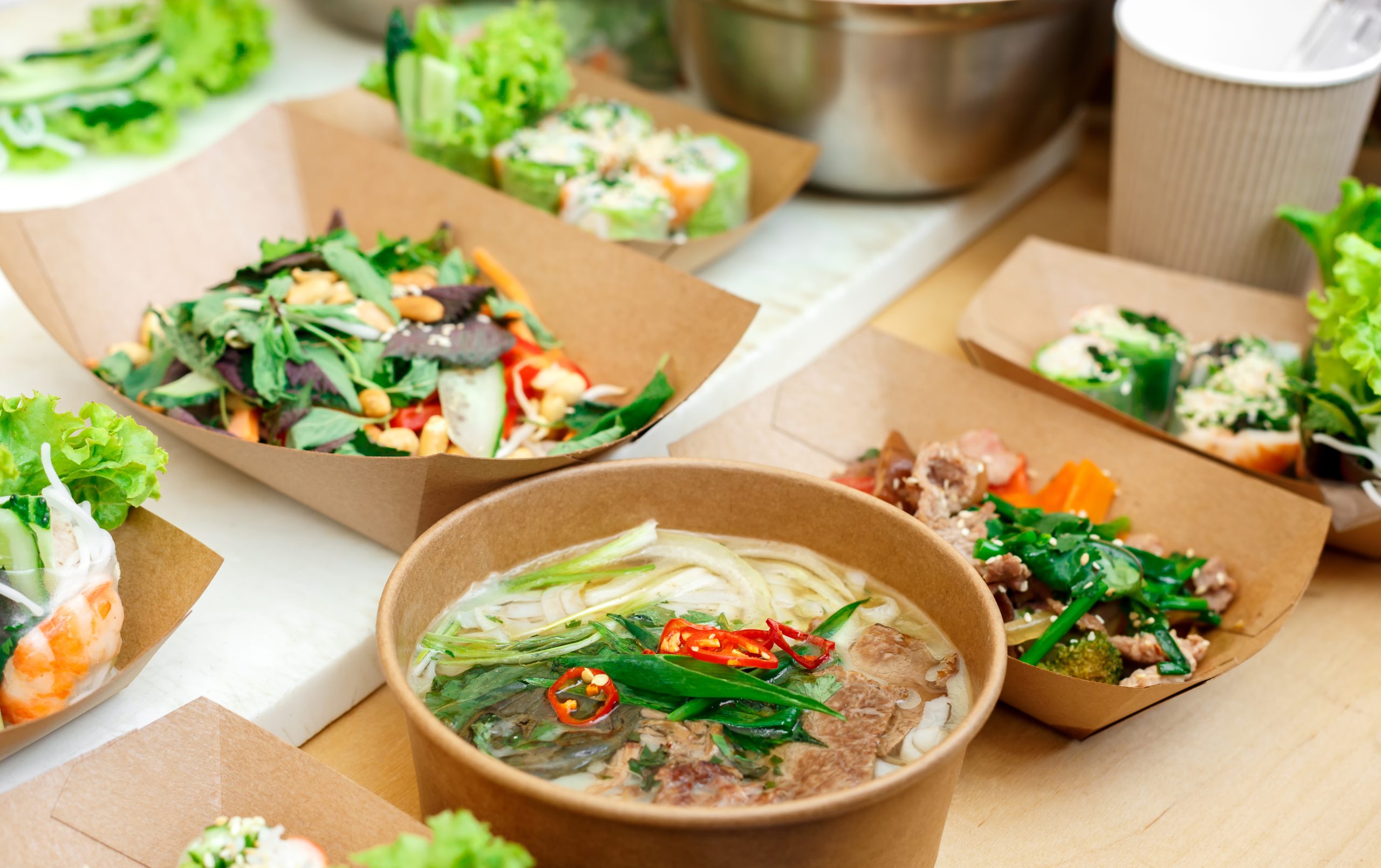
Bagasse packaging is made from sugarcane fibre, a byproduct of sugar production. It is sturdy, naturally oil and water-resistant, and suitable for both hot and cold food service. Unlike some paper-based alternatives, bagasse trays hold their shape even when food releases moisture over time, making them suitable for dressed salads, fruit portions with natural juices, and layered bowls where structural failure would ruin presentation. Bagasse is also compostable, giving it a clear advantage for businesses wanting to move away from plastic without sacrificing functionality.
For food businesses wanting their packaging to align fully with their environmental positioning, compostable food packaging offers a credible and practical solution. Materials commonly used include PLA (polylactic acid derived from plant starch), bagasse, and kraft board with compostable linings. Compostable options now cover almost every format a food business needs: salad boxes, clamshell containers, deli pots, soup cups, and cutlery. When sourcing compostable packaging for fresh food, look for EN 13432 certification, which confirms the product meets the European standard for industrial compostability and provides genuine assurance rather than relying on vague environmental claims.
Switching to eco-friendly packaging for fresh food involves more than picking a material. Operational, financial, and regulatory factors all affect which choices make sense for your specific operation.
The cost per unit of compostable and eco-friendly packaging sometimes carries a small premium over standard plastic equivalents. However, food businesses that factor in the cost of food wasted due to poor packaging often find the net cost difference is negligible. A salad box that keeps food fresh and presentable for longer generates more sales and less waste than a cheaper container that allows wilting and leakage within hours.
Some compostable materials are also sensitive to storage conditions. PLA products should be stored in cool, dry conditions away from direct heat or sunlight. Bagasse and kraft products are generally more robust but can absorb ambient moisture in damp environments. Ensuring your storage area is suitable for the materials you choose avoids packaging degradation before it reaches the customer.
Compostable packaging for fresh food is only genuinely compostable if it ends up in the right waste stream. Before marketing your packaging as compostable, check that industrial composting facilities are accessible through your waste collection arrangements. Transparency here builds trust with environmentally aware customers and avoids accusations of greenwashing.
UK food businesses also face increasing regulatory attention around packaging sustainability. The UK Plastic Packaging Tax applies a charge of £210.82 per tonne on plastic packaging containing less than 30% recycled plastic. Extended Producer Responsibility (EPR) obligations are expanding, creating a clear commercial incentive to reduce reliance on virgin plastic and explore compostable or recyclable alternatives.
Rather than overhauling your entire packaging inventory at once, audit your current packaging by product type and identify where sustainable swaps deliver the greatest impact.
Start by listing every fresh produce item you package, including salads, prepared fruit, sandwiches, baked goods, and cold prepared meals. Assess the specific protection each item needs: does it release moisture, is it fragile, does it need to be visible to the customer, or does it need to stay chilled? Match each item to the most suitable sustainable format, then source from a supplier that covers the full range. Working with a single supplier for your core packaging needs simplifies ordering, reduces delivery costs, and ensures consistency. Ambican supplies a comprehensive range of food-safe packaging for fresh produce, from salad containers and deli pots to bagasse trays and compostable options, with free delivery on orders over £130 excluding VAT and dispatch in one to two working days.
Always test before committing to bulk quantities. Order sample quantities of new formats and trial them with your actual food products over a few days, checking moisture performance, structural hold, lid security, and customer feedback before scaling up.
For UK food businesses, the shift towards sustainable packaging for fresh produce in the UK is driven as much by commercial logic as by environmental commitment. A 2023 WRAP survey found that 74% of UK consumers wanted businesses to use less plastic packaging. Food market organisers, local authorities, and event venues are also tightening rules, with many now requiring compostable or recyclable formats as a condition of trading.
Choosing eco-friendly packaging for fresh food signals to customers that your business takes quality and responsibility seriously. It also future-proofs your operation against tightening regulations and rising costs associated with plastic waste disposal. The businesses that move early tend to negotiate better supply terms and build stronger brand loyalty than those forced to switch reactively.
Browse Ambican’s range of sustainable packaging for fresh food and produce at ambican.com or call 0208 965 8399 to discuss your requirements. Salad boxes, bagasse trays, deli pots, clamshell containers, and compostable options are all available with one to two working day delivery across the UK.