Latest News

Packaging decisions now carry environmental, reputational, and operational weight. Customers, regulators, and supply chains increasingly expect businesses to demonstrate responsibility through their packaging choices. At Ambican, we help businesses across the UK navigate these decisions with clarity, balancing performance, cost, and sustainability. Understanding the Environmental Impact of Plastic Packaging compared with biodegradable alternatives allows businesses to reduce harm rather than simply shift it elsewhere.
The environmental impact of plastic vs biodegradable packaging depends on how materials are produced, used, and managed across their full lifecycle. Plastic packaging offers durability and efficiency but contributes to plastic pollution and carbon emissions, while biodegradable packaging can reduce long-term environmental harm when disposal systems are in place to support it.
Plastic packaging dominates food packaging, beverage containers, and consumer goods because it is lightweight, strong, and cost-effective. However, the environmental impact of plastic packaging extends far beyond its visible use and remains a central driver of global plastic pollution and long-term plastic waste management challenges.
Plastic production relies heavily on fossil fuels such as crude oil and natural gas. Virgin plastic is created through an energy-intensive production process that generates significant greenhouse gas emissions. As global plastic production continues to increase, the plastics industry remains a major contributor to climate change and overall resource consumption.
Globally, most plastic packaging is still produced using virgin materials, while only a small percentage is effectively recycled back into new packaging. This imbalance between production and recovery is a key driver of the plastic pollution crisis and increases the overall environmental impact of plastic packaging.
Plastic packaging becomes bad for the environment when it is not effectively recycled or recovered. Most plastic items are designed for single use, but persist in landfills or the natural environment for extended periods. Large volumes of plastic waste escape waste management systems each year, creating long-term environmental issues linked to poor plastic waste management.
Plastic bottles, grocery bags, and food containers can fragment into microplastics. These particles contaminate soil, rivers, and oceans, making plastic pollution an issue that extends far beyond visible litter and contributes to wider human health concerns.
Plastic pollution is one of the most damaging environmental issues linked to packaging. Marine litter harms marine life through ingestion and entanglement, disrupting ecosystems and biodiversity. Once plastic enters the ocean, it is extremely difficult to remove, allowing pollution to spread across vast marine environments.
Regions with limited waste management infrastructure are particularly affected. Plastic waste exported through international markets can overwhelm local systems, increasing environmental harm rather than reducing it.
Plastic recycling plays an important role in reducing waste, but it has clear limitations. Many plastic products are difficult to recycle due to contamination, mixed materials, or limited access to suitable recycling bins. Even when plastic is recycled, the material quality often degrades and cannot be reused indefinitely.
Some plastic packaging is diverted to energy from waste plants due to its high calorific value. While this recovers energy, it still produces carbon emissions and does not fully support circular economy goals.
Biodegradable packaging is often positioned as an alternative to conventional plastics, but its environmental performance depends heavily on how it is produced, used, and disposed of.
Biodegradable plastics are typically produced from renewable raw materials such as plant starches or cellulose. Unlike traditional plastics, biodegradable materials are designed to break down under specific conditions rather than stay in landfills or the natural environment for decades.
From a lifecycle perspective, biodegradable materials may reduce reliance on fossil fuels at the production stage, but they still require careful sourcing, processing, and transportation to keep overall environmental impact low.
Biodegradable packaging usually requires industrial composting conditions to break down effectively. These facilities use controlled environments and high temperatures to ensure materials decompose fully and safely.
When biodegradable materials are placed in a landfill or the natural environment, breakdown can be extremely slow. Clear labelling and consumer guidance are essential to prevent compostable materials from contaminating recycling bins and disrupting waste management systems.
When disposed of correctly, biodegradable packaging can reduce plastic waste and limit long-term environmental pollution. It is particularly effective for food packaging where contamination makes plastic recycling impractical.
However, biodegradable packaging still requires energy, land, and water to produce. Without access to suitable composting infrastructure, its environmental benefits may not be fully realised, meaning it is not automatically the most environmentally friendly option across its full lifecycle.
The environmental impact of packaging cannot be judged by disposal alone. A full lifecycle assessment considers raw material extraction, production, transportation, use and end-of-life processing.
Plastic packaging may perform well during use but carry higher environmental costs during production and disposal. Biodegradable packaging may reduce long-term waste, but it still requires significant resources upfront. Evaluating packaging across its entire lifecycle helps businesses reduce overall environmental impact rather than shifting it to another stage.
There is no universal answer when comparing plastic vs biodegradable packaging. The better option depends on how packaging is used, disposed of, and recovered.
Plastic packaging may offer environmental benefits when it contains high recycled content and operates within strong recycling systems. Biodegradable packaging can be more environmentally friendly where industrial composting facilities exist, and food waste contamination is unavoidable.
In many cases, reducing unnecessary packaging and choosing materials that align with effective plastic waste management or composting systems delivers the greatest environmental benefit.
Waste management systems vary significantly between regions. Some areas have well-developed recycling infrastructure, while others rely heavily on landfill or incineration. Packaging choices that work well in one location may perform poorly in another.
For businesses operating across multiple regions, aligning packaging materials with realistic disposal routes helps reduce environmental harm and prevents waste from entering the natural environment.
Consumer confusion around packaging disposal is a growing challenge. Compostable materials placed in recycling bins can contaminate recycling streams, while recyclable packaging placed in general waste reduces overall recycling rates.
Clear labelling, simple material choices, and consistent packaging formats help customers dispose of packaging correctly. Choosing packaging that aligns with common waste systems reduces contamination and improves recovery outcomes.
Packaging decisions should start with understanding food type, contamination levels, and local waste systems. Food containers heavily contaminated with waste may be better suited to compostable materials, while beverage containers and dry goods often perform well in recycling systems.
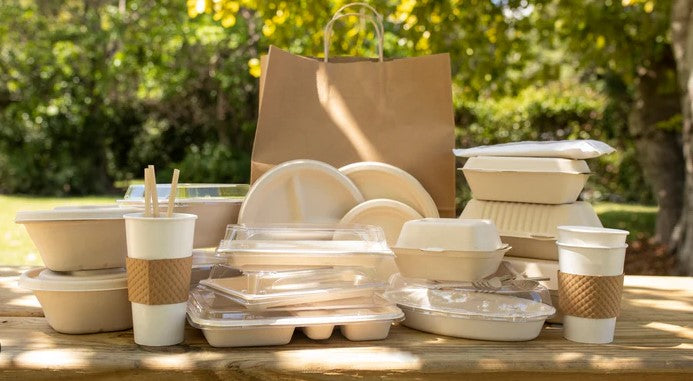
Many businesses begin by introducing eco-friendly food packaging that aligns with real-world disposal routes rather than switching materials without a clear strategy.
At Ambican, we help businesses make informed packaging decisions that balance sustainability with performance. Whether you are exploring compostable food packaging for takeaway meals or assessing recycled plastic options, our focus is on practical solutions that work in real-world conditions.
From everyday food containers to takeaway coffee cups, the right packaging choices can reduce environmental impact while maintaining food safety, reliability and customer trust.
Biodegradable packaging cannot replace plastic in all applications. Some products require durability, moisture resistance, or long shelf life that biodegradable materials may not provide. In certain cases, plastic packaging still performs better during transport and storage. A mixed approach often delivers better environmental outcomes when matched to the right use cases.
Most biodegradable materials are designed to break down in industrial composting facilities rather than landfills. Landfill environments often lack oxygen and suitable conditions, which slows decomposition significantly. As a result, biodegradable packaging may behave similarly to conventional plastics if disposed of incorrectly. Clear disposal guidance is essential to achieve environmental benefits.
Businesses can reduce environmental impact by cutting unnecessary packaging and simplifying material choices. Increasing recycled content and choosing materials that match local waste systems helps improve recovery rates. Clear labelling also reduces contamination in recycling and composting streams. Small packaging changes can deliver meaningful environmental improvements quickly.
Packaging choices influence exposure to plastic pollution and microplastics in food and water systems. Poorly managed plastic waste increases the risk of microplastics entering the food chain. Reducing unnecessary plastic packaging and improving disposal practices helps limit long-term environmental exposure. Responsible packaging supports both environmental and human health goals.